
Press Event: Honeycomb London 2025
August 16, 2025
Developer
If you just want to read about the products, scroll down to them under Day 2.
Day 1 - Travelling to London
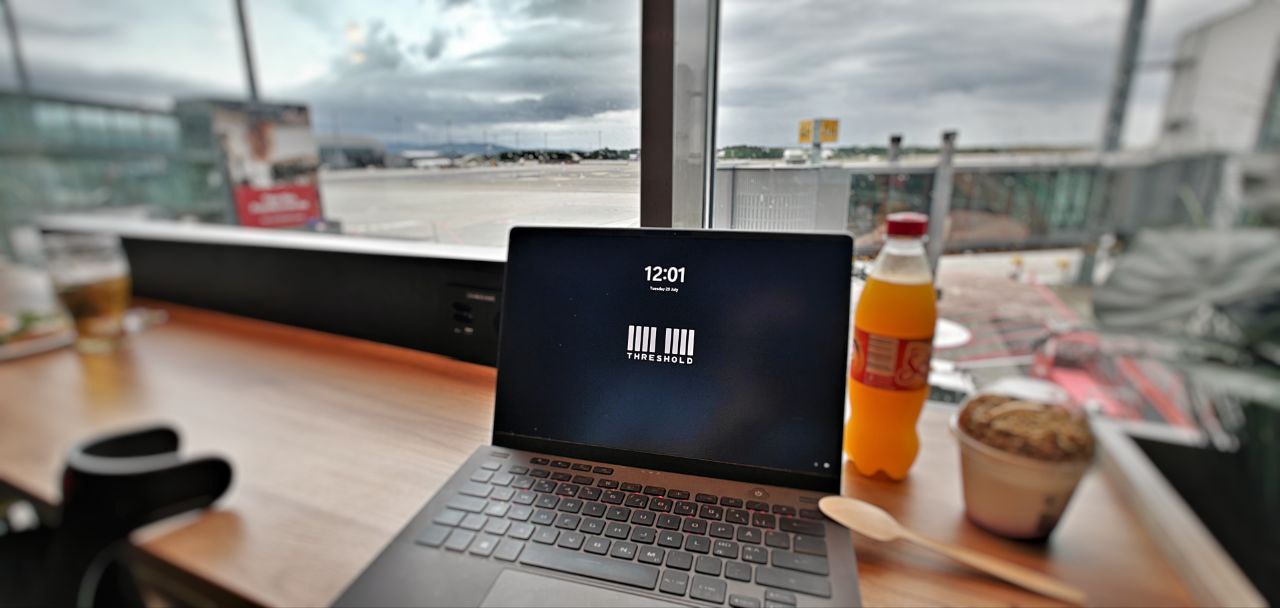
I must admit, I’ve never been to anything like this. Events like this aren’t exactly common in the flight sim community, if they even exist at all. The only other one I can recall was Microsoft’s launch event for MSFS 2020. Threshold wasn’t invited to that one. This time, though, Honeycomb Aeronautical has invited a select few to a press event, and as I sit at the airport waiting for my flight, I genuinely have no idea what awaits me in London.
Well, except for the now-familiar discomfort of travelling with a broken ankle. This marks my second trip this summer, hobbling around on crutches. At least I’m getting the hang of it.
I last encountered Honeycomb’s hardware lineup at FSExpo just a few weeks ago, but I barely had time to take it in. Between meetings, interviews, and everything else going on, I was so busy I hardly remembered what they had on display. I recall their lightweight versions of the Alpha and Bravo, a game controller, the Foxtrot joystick, and the Sierra TPM module, essentially a Bravo form factor with just the throttle, prop, and mixture levers. At FSWeekend back in March, most of these were still just renders, so FSExpo marked the debut of their physical prototypes.
That’s partly why I’m looking forward to this. With fewer distractions, I might finally get some hands-on time and a clearer understanding of where Honeycomb is heading next.
.jpg)
I can't help it, but my thoughts drift back to the internal conflicts that surfaced at Honeycomb over a year ago. I won’t dwell on the details, but I will say this: I’ve met most of the current Honeycomb team, and I really like them. They’ve all come across as warm, open, and genuinely interested in reconnecting with the community. The only person I haven’t met or heard from is Mike Steup. He never responded to my request for comment back when everything unfolded, and he has never appeared in any form since. Not that it matters today.
I’m going into this with an open mind. They paid for this trip, after all. So I’m here, curious, hopeful, and again travelling with a broken ankle. Let’s see what tomorrow brings.
Day 2 - The Event
I woke up in London. The reality of being here didn’t truly hit me until I stepped outside and found myself surrounded by grand imperial architecture and cars driving on what, to my Norwegian brain, is the wrong side of the road. On trips this short, you don’t get the luxury of acclimating. You’re dropped into a city and already returning home before you know it.
A quick hop, just a few blocks from my hotel, brought me to the venue. At the entrance, I was greeted by Poppy, Honeycomb Aeronautical’s warm and welcoming PR manager (From Overload PR), who had orchestrated the whole event. Honeycomb had scheduled different time slots for various invited media, and Jacob Little from PC Pilot was just wrapping up his session as I arrived.

After a much-needed coffee and some easy conversation with people who would feel like friends by the end of the day, I was guided into a dedicated room where Honeycomb had set up multiple test stations for their hardware. I shared my slot with Emmanuel Blanchard from Micro Simulateur, a long-running French flight simulation magazine that, sadly, is publishing its final edition before shutting down entirely.
The products
Honeycomb Aeronautical didn’t unveil anything brand new at this event. Well, not anything unknown anyway. It was the same lineup I’d seen before, each set up on a dedicated “flight sim station”. Before diving into specifics, it’s important to note that none of these are final production models. Every unit was at a different stage of prototyping, and part of the reason we were here was to give feedback. Feedback that could help shape sensible refinements before these products make it out into the world.
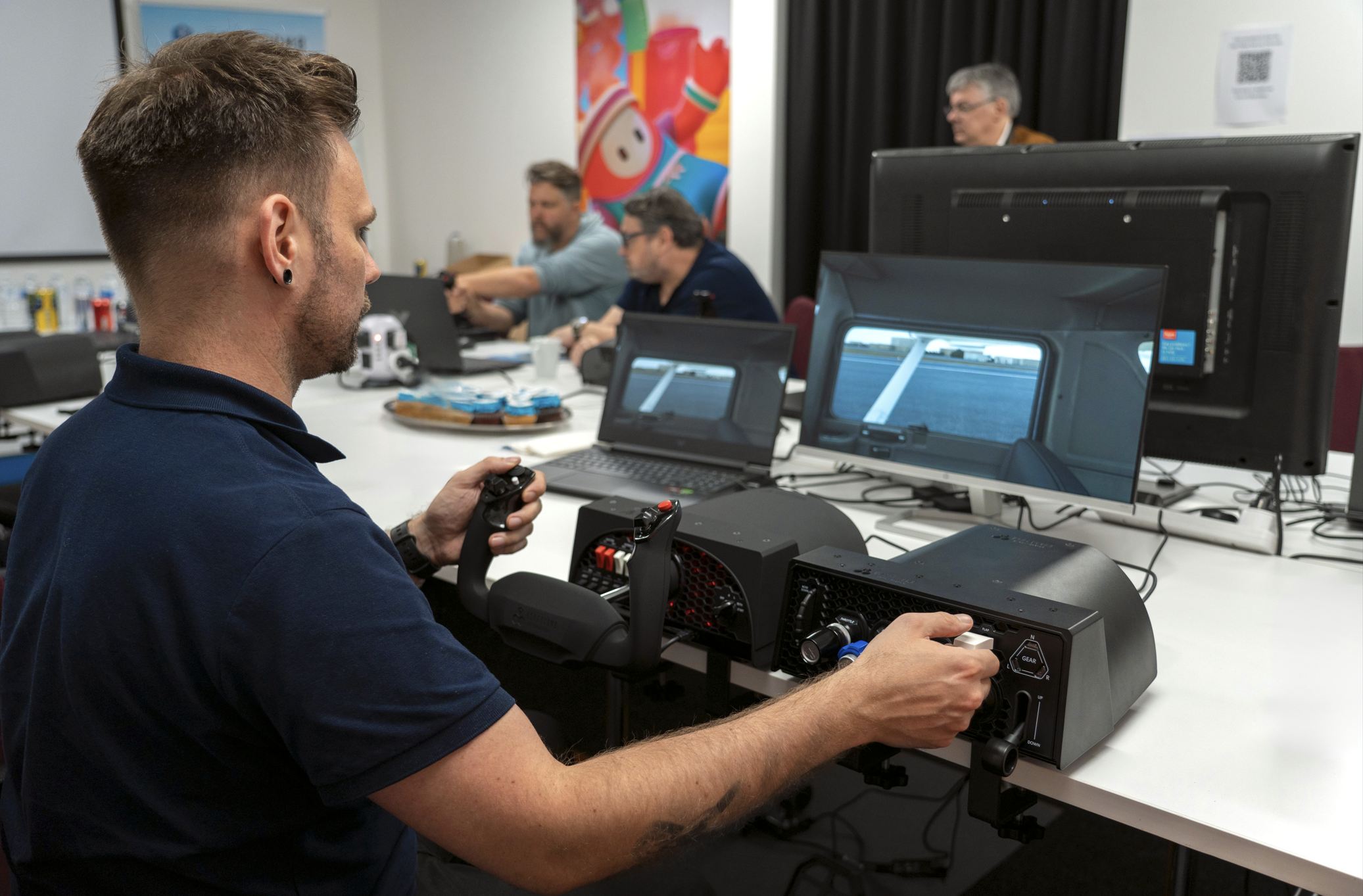
I like this approach from manufacturers a lot. I’ve seen it with MOZA and a few other brands, but here, it felt like it was taken to another level. We weren’t just seeing early hardware. I sat down with Honeycomb’s chief engineer, Marc Küpper, and had the chance to give direct, unhurried input on each product, with the engineer listening intently and asking the right questions.
Let’s talk about the products. That’s why we are here after all.
Bravo Throttle Quadrant Lite - $199.99
When the original Bravo Throttle Quadrant launched several years ago, it was nothing short of a disruptor. It shook up the entire hardware scene and forced the stale, overpriced, and overly traditional manufacturers to rethink their strategies from the ground up. I’d go as far as to say the Bravo helped change the trajectory of the entire flight sim hardware market.
.jpg)
The new Bravo Lite is priced at $199.99, a more affordable option than the $299.99 full-sized Bravo. Dimension-wise, it matches the original, but it pares back on functionality, offering four levers instead of six. It still includes interchangeable throttle handles, as we’ve come to expect from Honeycomb, and the addition of larger Boeing-style levers is a fantastic inclusion - a big step up, even. I think I recall that these will also be available, included or for purchase, for the big Bravo when the new version launches. The Bravo Lite uses a slightly different lever base to accommodate the flap detent brackets, which means the lever extensions won’t be interchangeable with the full-sized Bravo.
One other notable change is the trim wheel. The Lite uses a smaller GA-style wheel instead of the larger one found on the original. Honeycomb told me this was due to some reports of the larger wheel breaking off. That surprised me, because I’ve lost count of how many times my swivelling office chair has smacked into mine, and it’s still going strong today.
.jpg)
I also appreciate the addition of a dedicated parking brake lever. Something the original Bravo lacked, and I had to assign it to a button instead. My only gripe is the material of that particular handle. The Bravo, in general, has a higher mid-range feel to it. Buttons and levers are pleasing to the touch. The parking brake lever feels cheap and out of place, and I hope that changes before release.
If your budget allows, I’d personally go for the full-sized Bravo. It is still unmatched as a versatile and well-executed throttle quadrant. But I can definitely see the case for the Lite, especially for simmers who want the core functionality at a lower price point.
Alpha Flight Controls Lite - $199.99
When the original Alpha launched, it didn’t quite have the same market-shaking impact as the Bravo, but it came close. At the time, most alternatives in its price range were frankly rubbish and extortionately overpriced for what you got. The Alpha quickly became the go-to choice for anyone wanting a quality yoke without spending a fortune.
The Alpha Lite is exactly what it sounds like: a simplified version of the original. The footprint, feel, and core mechanics are identical, which is a good thing. I’ve used the Alpha for many years and loved it. The only reason I stopped using it was when I upgraded to a force feedback yoke.
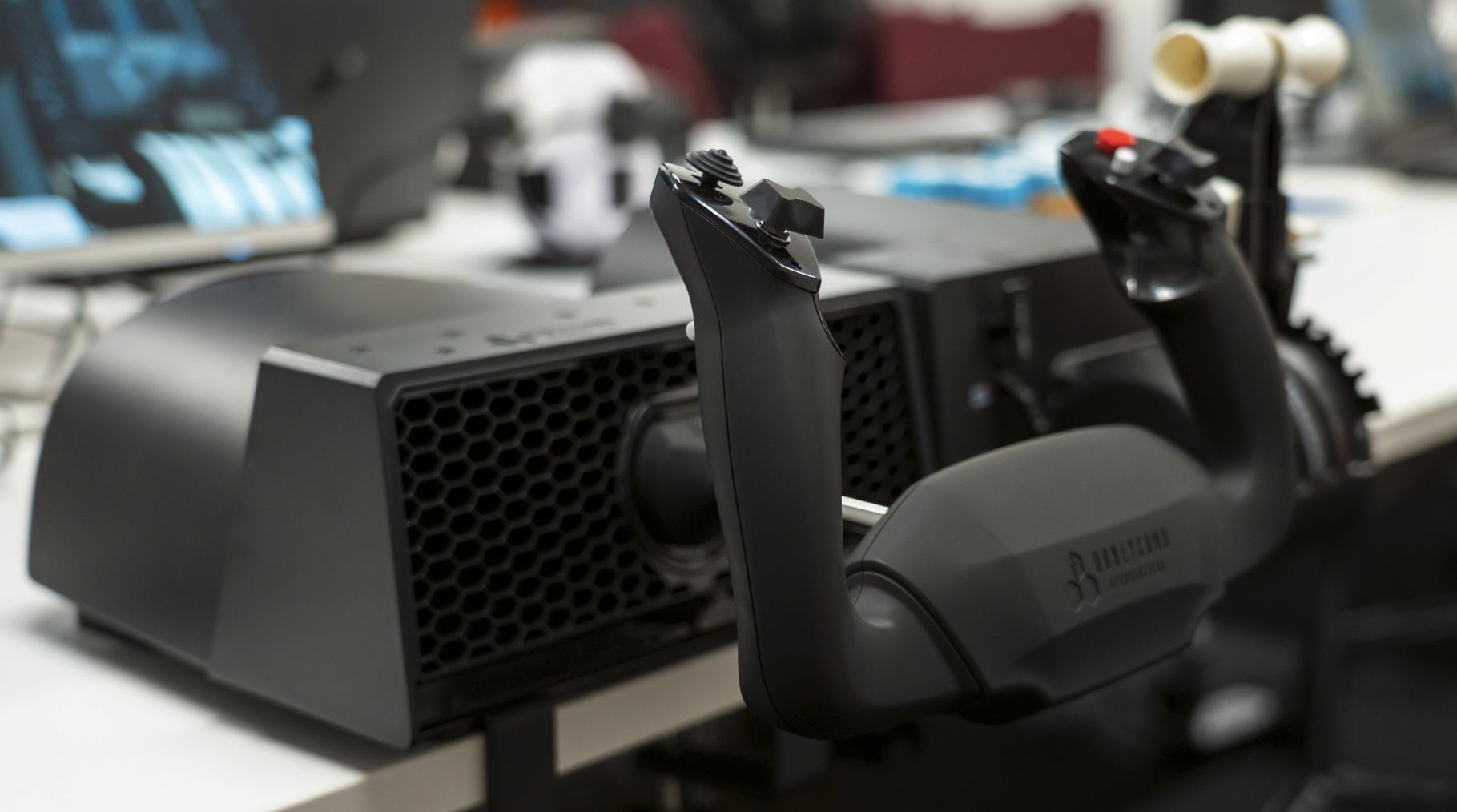
There’s not much more to add here: I can still recommend the Alpha without hesitation. The Lite keeps the fundamentals that made the original great, but now at a lower price point.
Sierra TPM Module - $249.99
This turned out to be my favourite in the lineup. That’s saying something because TPM modules are about as niche as they get. Flight simulation is a niche hobby, and dedicated GA flying is an even smaller slice. So when Honeycomb Aeronautical decided to make one, I was pleasantly surprised. I’ve wanted a high-quality TPM for years, but never found one that struck the right balance between build quality and a price I was willing to pay.
Since its announcement in March, I’ve been so busy that I haven't looked into it in detail. Even at FSExpo, despite being the product I was most excited about from Honeycomb, I completely forgot about it.

When I finally saw it, my first thought was: Why is it so big? It has the same footprint as the Bravo because it uses the Bravo base. Initially, that felt unnecessary until I learned that the lever travel is nearly as long as the base is deep. That immediately grabbed my attention because, as far as I know, it’s true to, or close to, the real-world dimensions. In that light, reusing the Bravo base makes sense, and it likely saves on tooling costs as well.
Once I sat down with it, I was hooked. The quality of the TPM levers is outstanding. The base and the rest of the build are the solid mid-tier quality you’d expect from Honeycomb, but the levers are 'chef’s kiss'. The plastic has a finish that reminds me of the Thrustmaster HOTAS grip. Almost ceramic-like, with that 'built-to-last feel of products from the 1960s that still work today. Someday, far in the future, archaeologists will dig these up and say: “We don’t make things like this anymore. They knew what they were doing back in the mid 2020s.”

Using the levers is an experience in itself. The throttle lever has a metal ring at the base to adjust tension. The propeller and mixture levers offer fine adjustments by rotating the handles. All three levers feature a metal button at the tip that must be pressed to operate them. Just like the real thing. This unit also includes a GA-style trim wheel, just like the Bravo Lite, which is a nice touch.
My only concern is the price. Not because I in any way think you don’t get what you expect. On the contrary. But at $249.99, this is a niche product within a niche market, and I’m not sure how many people will commit at that price point. That said, the quality is so unexpectedly high that I hope it finds its audience. Could they have made a cheaper, more 'mid-tier' version for $100? Maybe. But in my opinion, cutting corners here would have ruined what makes it special. I really hope this bold move pays off for Honeycomb.
Foxtrot Aviation Stick - $149.99
The Foxtrot features an ambidextrous design for both left- and right-handed pilots, something most of the big names in flight sim hardware still overlook. In my opinion, the Foxtrot isn’t revolutionary, but it’s also not a bad product to have in the market. Competition is healthy, and this adds another solid option to the mix.
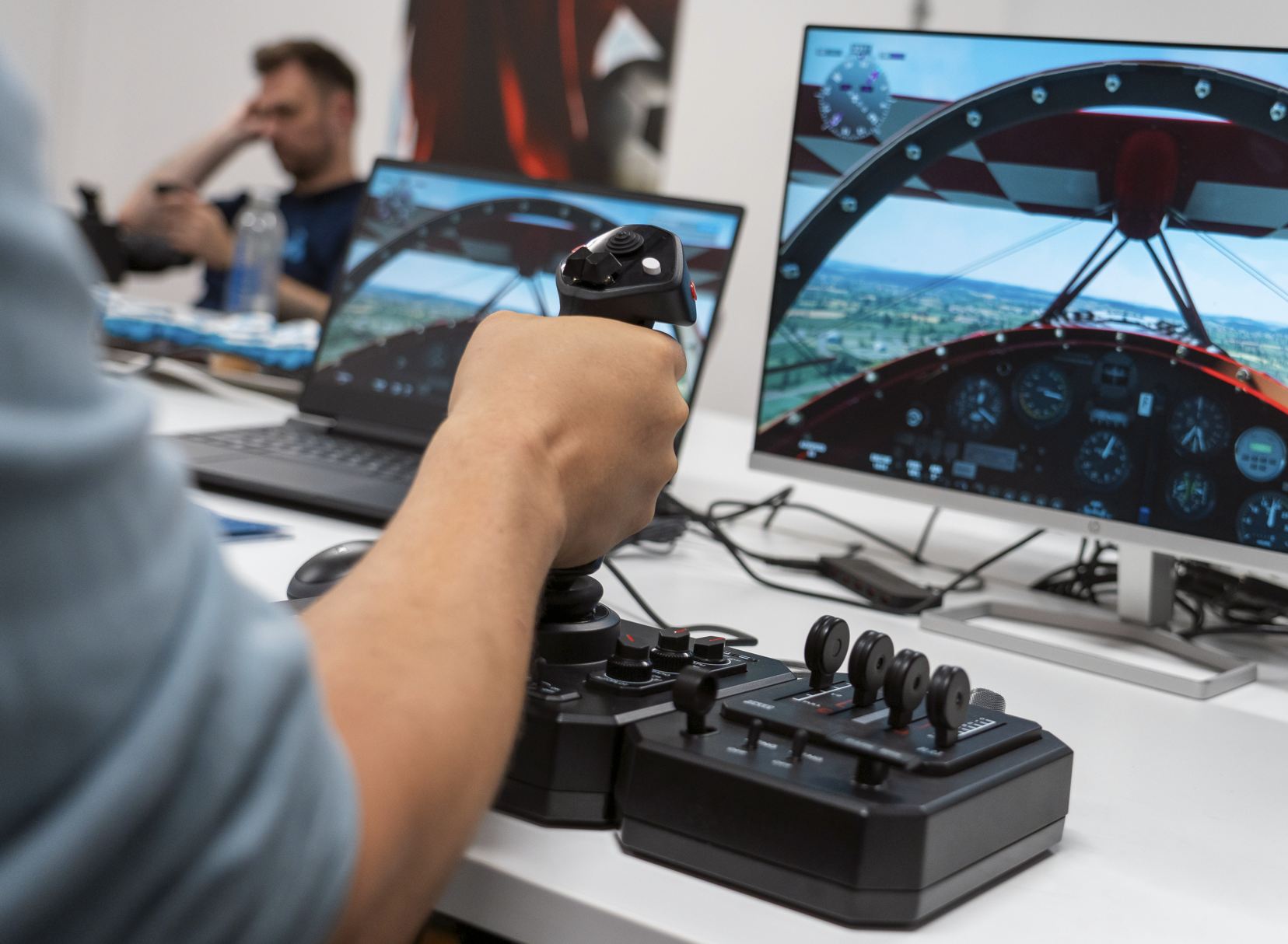
That said, the buttons would benefit from feeling firmer and of higher quality. I also mentioned the need for an analogue index-finger trigger or an additional analogue button. In its current form, the Foxtrot doesn’t offer a way to control braking unless you have rudder pedals. I’m convinced this will be addressed in the final product. And I repeat, these are not the final versions of these products. That is the whole point of this event.
.jpg)
One of my more interesting discussions with lead engineer Marc was about coating the joystick shaft with a higher-quality plastic. As it stood before me, the stick felt a little bare and 'plasticky'. The idea of adding a premium coating has clear appeal. It would immediately give the stick a more solid, high-end feel, improve grip and visually elevate it to match higher-tier hardware. On the other hand, such coatings can wear off or peel over time, they’re more prone to showing scratches and marks, and they inevitably add to production costs. That trade-off between tactile appeal and long-term durability is something Honeycomb will have to weigh carefully before finalising the design.

At $150, the Foxtrot is stepping into a fiercely competitive space. The joysticks market is already saturated, and going up against something like Turtle Beach’s VelocityOne Flightstick, priced just $10 less, won’t be easy. That stick offers some compelling features for the money, including an integrated throttle and flaps lever. By comparison, adding Honeycomb’s separate throttle box to the Foxtrot increases the price by another $30. The throttle box does provide more buttons overall, but I can’t say its quality thoroughly convinced me during my hands-on time.
.jpg)
I’m not entirely sure what Honeycomb needs to do here to meet expectations at this price point while keeping costs in check. One improvement I would like to see, which could become a real selling point, is making the throttle module fully ambidextrous in seconds. As it is now, switching the throttle from one side of the stick to the other means unscrewing it from the base and reattaching it on the opposite side. That’s fine for a one-time setup, but when I jump from an Airbus to a fighter jet in the sim, I want the joystick to adapt just as fast. Achieving that kind of quick-swap capability wouldn’t be a headline feature on its own, but it could be one of those small quality-of-life touches that make the Foxtrot stand out in a challenging market.
.jpg)
After all, Honeycomb needs a joystick in its lineup. This iteration, still in the early stages of prototyping, shows promise, but it needs more work before it’s ready to make a real impact. One idea worth exploring, especially given the current lack of analogue braking, would be an analogue brake button or lever on the throttle base, positioned so it can be comfortably reached with the thumb or otherwise accessible with the throttle on either side of the joystick. I have no idea if this would work in practice, but experimenting with a brake solution on the throttle could be a genuinely new idea, and perhaps one that helps the Foxtrot stand out in a crowded market.
Echo Aviation Controller - $99.99 - Proof of Concept
This gamepad turned out to be more interesting than I initially expected. Several companies are now exploring handheld controllers dedicated to flight simulation, with the Yawman Arrow already on the market. The Yawman delivers an OK experience that is perfectly serviceable for what it sets out to do.
The unit I tested was a proof-of-concept prototype, so it felt light and a bit unrefined, which is what you’d expect at this phase. Even so, there were hints during my hands-on time that this could become something quite special once fully developed. Marc explained that specific changes are planned before launch.
.jpg)
One of those changes will be moving the throttle and flaps/air brake levers further to the right, which makes sense ergonomically. The production version will also be heavier than this prototype, since the model I tested didn’t include the rumble mechanism. We discussed how a slightly heavier controller can convey a higher sense of quality, but that balance is tricky since it still needs to be light enough to avoid fatigue during extended use.
The trim wheel will also most likely be redesigned into a scroll wheel. I think that’s a great idea. Especially if it ends up like the metallic wheel on the Logitech MX Master 3S, which can also be pressed to enable step-less scrolling. That was my immediate suggestion. But again, it comes down to the balance between cost, quality, and features.
I also suggested moving the left thumbstick further down for better comfort. Whether that change makes it into the final version remains to be seen, but I commend Honeycomb for creating a relaxed environment where direct feedback is encouraged. The thumbstick itself featured linear movement on the up/down axis and a spring-loaded left/right axis - a combination that felt great in use.
.jpg)
When I asked if it would be wireless, the answer was no, and worse, it’s planned to ship with a permanently attached cable. I can’t agree with that decision. In 2025, any controller should be wireless. The reasoning behind the fixed cable is faster reaction time, but in a flight sim, this simply doesn’t matter. And if you’re the dogfighting ace of the century, desperately squeezing out every millisecond of latency, you can just plug in the USB cable, which I fully expect to be USB-C.
.jpg)
The dedicated flight sim controller space is at risk of becoming crowded quickly. There’s still room for competition, but with Meridian GMT stepping in from the sidelines with a promising modular prototype, any newcomer will need standout features and zero missing essentials to secure a slice of the market. The existing Yawman works fine as a dedicated flight sim gamepad, but I’ve found it lacking. The beige-grey colour feels like a 1990s office computer, the build is light and plasticky, and while the fixed rudder feature is clever, it also locks the only analogue trigger in the front to a single axis, limiting its versatility. A solution for a lock/unlock mechanism could turn that from a limitation into a strength.
.jpg)
As it stands, I see two controllers with the potential to dominate this niche: Meridian’s modular gamepad and Honeycomb’s Echo. Meridian’s prototype, which I also tried at FSExpo, is already surprisingly polished. Honeycomb’s version is earlier in its development cycle but could easily become a strong contender. And if Yawman doesn’t step up, they’ll find themselves in third place before long.
Day 3 - Trip Home and Afterthoughts
Honeycomb has had a rough patch in recent years, with a reputation that still lingers in certain corners of the community. I still hear people say their customer support is poor, or that they don’t deliver on promised products. That was true a year ago. I firmly believe it’s no longer the case. As Michael Auer, Head of Global Sales & Marketing at Honeycomb Aeronautical, told me, these are exactly the areas they’re working hardest to improve. “We want to be the industry leaders in customer support, product quality, and innovation.”
It’s an ambitious goal, and the road ahead won’t be easy. Honeycomb, however, already holds a substantial market share and a strong presence. At almost every expo in recent years, their products have been visible at nearly any booth that doesn’t produce its own hardware. Even so, the market is becoming increasingly saturated, and staying relevant will require constant innovation and attention to detail. After meeting the team, hearing their plans, and seeing their prototypes up close, I think they have a real chance. They’re listening, they’re willing to make changes, and they clearly care about their products, and their customers, leaps more than the ghosts of last year’s reputation might suggest.

Flying home, ankle still protesting every step, I thought back to sitting at the airport on day one with no idea what awaited me in London. Now I know. I’ve seen the hardware, yes, but more importantly, I’ve seen the people behind it, their openness to feedback, awareness of the challenges ahead, and genuine passion for what they make. If they can carry that mindset into every decision, Honeycomb might surprise a few people in the coming years - maybe even the ones still holding onto old grievances. And I have to give them credit: hosting an event like this for the press in our niche community is no small thing. It shows confidence, transparency, and a willingness to engage directly. Something I’d like to see more companies in this space have the courage to do.
Share this page



COMMENT ADVISORY:
Threshold encourages informed discussion and debate - though this can only happen if all commenters remain civil when voicing their opinions.

.webp)





.webp)
